Wednesday, 30 October 2013

PHP- Language for Web Devlopment


PHP development began in 1994 when the developer Rasmus Lerdorf wrote a series of Common Gateway Interface (CGI) Perl scripts, which he used to maintain his personal homepage. The tools performed tasks such as displaying his résumé and recording his web traffic. He rewrote these scripts in C for performance reasons, extending them to add the ability to work with web forms and to communicate with databases, and called this implementation "Personal Home Page/Forms Interpreter" or PHP/FI. PHP/FI could be used to build simple, dynamic web applications.

PHP is a server-side scripting language designed for web development but also used as a general-purpose programming language. PHP is now installed on more than 244 million websites and 2.1 million web servers. Originally created by Rasmus Lerdorf in 1995, the reference implementation of PHP is now produced by The PHP Group. While PHP originally stood for Personal Home Page, it now stands for PHP: Hypertext Preprocessor, a recursive acronym.
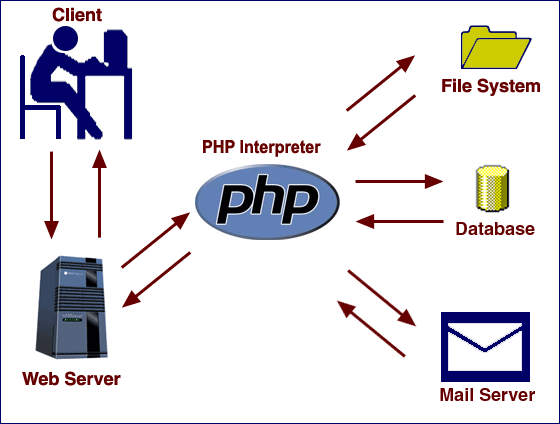
PHP code is interpreted by a web server with a PHP processor module, which generates the resulting web page: PHP commands can be embedded directly into an HTML source document rather than calling an external file to process data. It has also evolved to include a command-line interface capability and can be used in standalone graphical applications.
PHP is free software released under the PHP License, which is incompatible with the GNU General Public License (GPL) due to restrictions on the usage of the term PHP. PHP can be deployed on most web servers and also as a standalone shell on almost every operating system and platform, free of charge.

Tuesday, 29 October 2013

Computer Tricks #1

                         RUN TWO WINDOWS 8 APPS SIDE BY SIDE

Windows application are normally full screen, whether its appropriate for this apps to take up the entire screen or not.
Though you can not run the app in the windowed mode,  like you are use to with windows 7 and earlier ,
its still possible to run two apps side by side.

STEP 1 : Move the mouse pointer towards the top of the app until you see it turns into a hand.

STEP 2 : Click and hold the mouse button at the top, than move the app to the left or the right side of the                     screen.

STEP 3 : The app now takes up a sliver of the left or right side of the screen.

STEP 4 : Press the windows key again and choose another app , and the second app take up the rest of the                screen.

STEP 5 : You can switch sides for the sliver app and change places with the primary app but you are struct                  with two width, most of the screen and and sliver of the screen.


NOTE :-  This side by side feature also interacts with the windows desktop. if you are running apps that resides on  the desktop such as an  MS office than putting a window app side by side with the desktop will show all your open desktop apps, stacked along the right side.

Monday, 28 October 2013

Java Programming Language


Java is a general-purpose, concurrent, class-based, object-oriented computer programming language that is specifically designed to have as few implementation dependencies as possible. It is intended to let application developers "write once, run anywhere" (WORA), meaning that code that runs on one platform does not need to be recompiled to run on another. Java applications are typically compiled to bytecode (class file) that can run on any Java virtual machine (JVM) regardless of computer architecture. Java is, as of 2012, one of the most popular programming languages in use, particularly for client-server web applications, with a reported 9 million developers. Java was originally developed by James Gosling at Sun Microsystems (which has since merged into Oracle Corporation) and released in 1995 as a core component of Sun Microsystems' Java platform. The language derives much of its syntax from C and C++, but it has fewer low-level facilities than either of them.
The original and reference implementation Java compilers, virtual machines, and class libraries were developed by Sun from 1991 and first released in 1995. As of May 2007, in compliance with the specifications of the Java Community Process, Sun relicensed most of its Java technologies under the GNU General Public License. Others have also developed alternative implementations of these Sun technologies, such as the GNU Compiler for Java(bytecode compiler), GNU Classpath (standard libraries), and IcedTea-Web (browser plugin for applets).

Friday, 11 October 2013

C# Language


C# (pronounced see sharp) is a multi-paradigm programming language encompassing strong typing, imperative, declarative, functional, procedural, generic, object-oriented (class-based), and component-oriented programming disciplines. It was developed by Microsoft within its .NET initiative and later approved as a standard by Ecma and ISO. C# is one of the programming languages designed for the Common Language Infrastructure.
The name "C sharp" was inspired by musical notation where a sharp indicates that the written note should be made a semitone higher in pitch. This is similar to the language name of C++, where "++" indicates that a variable should be incremented by 1.

Versions of C#:-

  • C# 2.0
  • C# 3.0
  • C# 4.0
  • C# 5.0 


Syntax:

  1. Semicolons are used to denote the end of a statement.
  2. Curly braces are used to group statements. Statements are commonly grouped into methods (functions), methods into classes, and classes into namespaces.
  3. Variables are assigned using an equals sign, but compared using two consecutive equals signs.
  4. Square brackets are used with arrays, both to declare them and to get a value at a given index in one of them.

Tuesday, 8 October 2013

Tips for Beginner Photographers

1. Don’t go crazy buying the most expensive equipment right away.

It’s possible to get very nice photos with an inexpensive point and shoot. See these examples on Flickr. The more photos you take, the more you’ll know about what kind of camera to get when it’s time to upgrade.

2. Consider a tripod.

On the other hand, an inexpensive tripod is worth getting, especially if you have shaky hands like mine. When I got a tripod, my satisfaction with my shots skyrocketed. For even more stability, use your camera’s timer function with a tripod (read our introduction to tripods).

3. Keep your camera with you all the time.

Photo ops often come when you least expect it. If you can keep your equipment relatively simple – just a small camera bag and a tripod – you might be able to take advantage of some of those unexpected opportunities. Or, if your phone has a camera, use it to take “notes” on scenes you’d like to return to with your regular camera.

4. Make a list of shots you’d like to get.

For those times you can’t carry your camera around, keep a small notebook to jot down places you’d like to come back and photograph. Make sure to note any important details, like the lighting, so you can come back at the same time of day or when the weather’s right. If you don’t want to carry a notebook, send yourself an email using your cell phone with Jott.com.

5. Don’t overlook mundane subjects for photography.

You might not see anything interesting to photograph in your living room or your backyard, but try looking at familiar surroundings with fresh eyes. You might catch an interesting trick of the light or find some unexpected wildflowers in your yard. Often a simple subject makes the best shot.

6. Enjoy the learning process.

The best part of having a hobby like photography is never running out of things to learn. Inspiration is all around you. Look at everything with the eyes of a photographer and you’ll see opportunities you never noticed before.

7. Take advantage of free resources to learn.

Browse through Flickr or websites like the Digital Photography School Forum for inspiration and tips. Also, your local library probably has a wealth of books on all types of photography. If you’re interested in learning about post-processing, give free software like the GIMP a try.
8. Experiment with your camera’s settings.

Your point and shoot may be more flexible and powerful than you know. Read the manual for help deciphering all those little symbols. As you explore, try shooting your subjects with multiple settings to learn what effects you like. When you’re looking at your photos on a computer, you can check the EXIF data (usually in the file’s properties) to recall the settings you used.

9. Learn the basic rules.

The amount of information about photography online can be overwhelming. Start with a few articles on composition. Be open to what more experienced photographers have to say about technique. You have to know the rules before you can break them.

10. Take photos regularly.

Try to photograph something every day. If you can’t do that, make sure you take time to practice regularly, so you don’t forget what you’ve learned. An excellent way to motivate yourself is by doing the weekly assignments in the DPS Forum.

11. Don’t be afraid to experiment.

If you’re using a digital camera, the cost of errors is free. Go crazy – you might end up with something you like. You’ll certainly learn a lot in the process.

Saturday, 5 October 2013

C++ Language


C++ is a programming language that is general purpose, statically typed, free-form, multi-paradigm and compiled. It is regarded as an intermediate-level language, as it comprises both high-level and low-level language features. Developed by Bjarne Stroustrup starting in 1979 . C++ was originally named C with Classes, adding object oriented features, such as classes, and other enhancements to the C programming language. The language was renamed C++ in 1983, as a pun involving the increment operator.

C++ is one of the most popular programming languages and is implemented on a wide variety of hardware and operating system platforms.

C++ is also used for hardware design, where the design is initially described in C++, then analyzed, architecturally constrained, and scheduled to create a register-transfer level hardware description language via high-level synthesis.

C++ is one of the most popular programming languages and is implemented on a wide variety of hardware and operating system platforms. As an efficient compiler to native code, its application domains include systems software, application software, device drivers, embedded software, high-performance server and client applications, and entertainment software such as video games. Several groups provide both free and proprietary C++ compiler software, including the LLVM, Microsoft and Intel. C++ has greatly influenced many other popular programming languages, most notably C# and Java.

C Language


In computing, C is a general-purpose programming language initially developed by Dennis Ritchie in 1969. C has facilities for structured programming and allows lexical variable scope and recursion, while a static type system prevents many unintended operations. Its design provides constructs that map efficiently to typical machine instructions, and therefore it has found lasting use in applications. C is low level language.
C is one of the most widely used programming languages of all time, and C compilers are available for the majority of available computer architectures and operating system.
The C language exhibits the following characteristics:
->There is a small, fixed number of keywords, including a full set of flow of control primitives: for, if/else, while, switch, and do/while. There is one namespace, and user-defined names are not distinguished from keywords by any kind of sigil.
->There are a large number of arithmetical and logical operators, such as +, +=, ++, &, ~, etc.
->More than one assignment may be performed in a single statement.
->Function return values can be ignored when not needed.
->Declaration syntax mimics usage context. C has no "define" keyword; instead, a statement beginning with the name of a type is taken as a declaration. There is no "function" keyword; instead, a function is indicated by the parentheses of an argument list.
->Low-level access to computer memory is possible by converting machine addresses to typed pointers.

->Function and data pointers permit ad hoc run-time polymorphism